

Best Type B RCD for EV Charger Installations: What to Know Before Buying
2026-08-23
Every EV charger installation lives or dies by the quality of its residual current protection—and when it comes to modern electric vehicles, a generic AC-only RCD simply won't cut it. Type B RCDs are built to detect the smooth DC residual currents that EV chargers can produce, but the market is flooded with options that vary wildly in performance and reliability. Before you spend your money, you need to know what actually matters: response time, immunity to nuisance tripping, and compliance with the latest standards. That's where a focused manufacturer like ETEK comes into the picture, offering solutions designed to meet the specific demands of EV charging without the guesswork. Here's what to evaluate before buying.
Why a standard AC or A type RCD won't cut it for your EV charger
Most household residual current devices are built for the predictable alternating current faults found in everyday appliances. An electric vehicle charger, however, creates a far messier electrical signature. During charging, the onboard rectifier can produce smooth DC residual currents, especially if there is an insulation failure. A standard AC type RCD simply cannot detect these; it is designed to trip only on sinusoidal AC leakage. The result is a dangerous blind spot where a serious fault can go completely unnoticed.
Moving up to an A type RCD seems like a sensible step, since it responds to pulsating DC as well as AC. But even that is not enough for modern EVs. Many chargers incorporate complex power electronics that can inject a mixture of residual currents with a DC component exceeding 6 mA. Once that threshold is crossed, an A type RCD can become desensitized or fail to trip altogether. The iron core in its current transformer saturates, and the very protection you rely on is effectively disabled.
This is why dedicated EV installations now call for a type B RCD or an equivalent solution with built-in DC fault detection. These devices are engineered to handle smooth DC leakage without losing sensitivity, ensuring they trip precisely when they should. Skimping on the wrong RCD type doesn't just risk nuisance tripping or a failed inspection; it leaves a genuine safety gap that could have severe consequences for anyone using or maintaining the charging point.
Decoding the DC leakage detection specs that actually matter in a Type B RCD
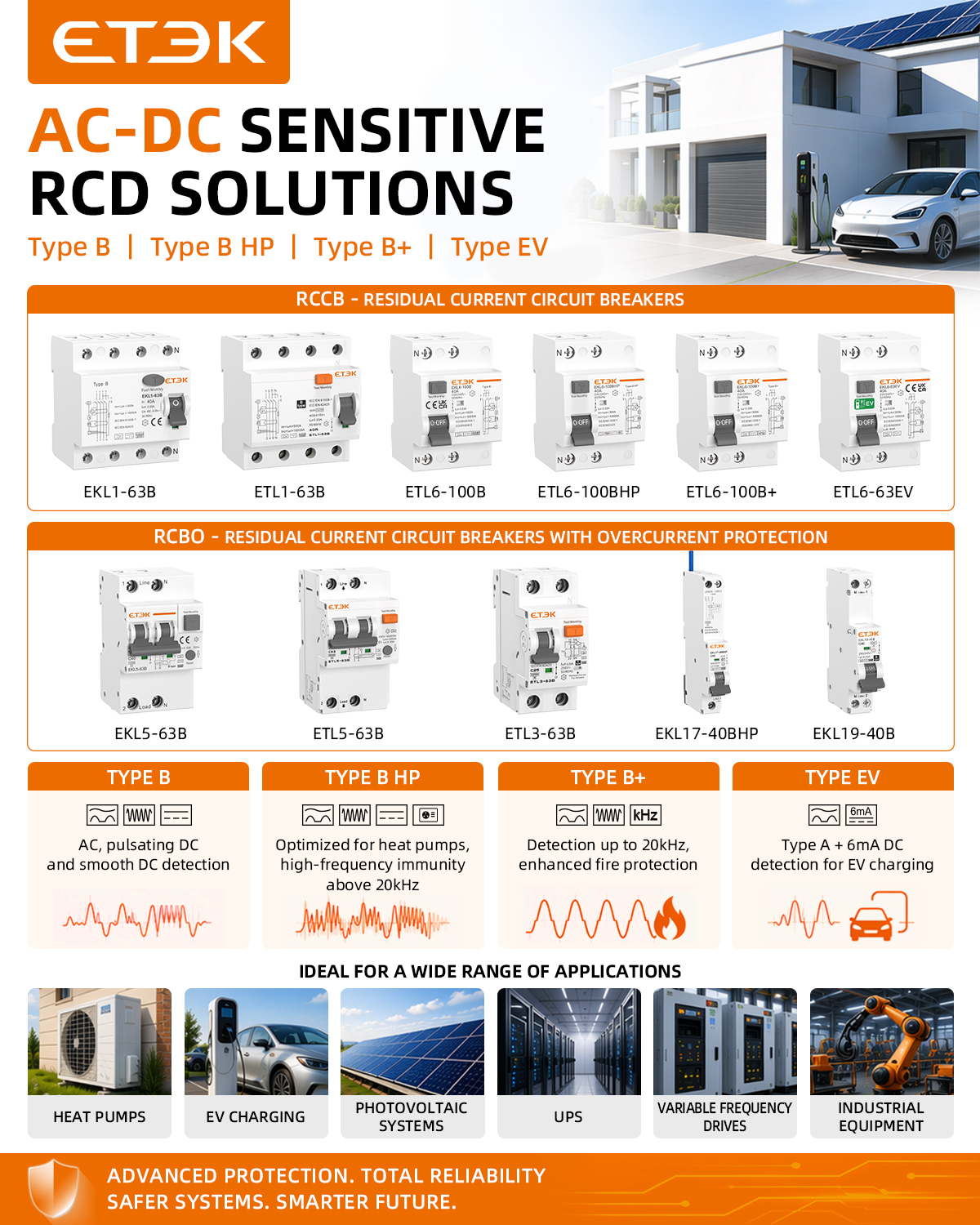
The typical spec sheet for a Type B RCD will boast about detecting "smooth DC residual currents," but that phrase hides a messy reality. Fault currents from modern power electronics rarely show up as a pure, flat DC offset. Instead, you're usually dealing with a shifting mix of AC components, rectified pulses, and a slowly wandering DC baseline. The detection thresholds quoted for laboratory conditions with a clean DC source often have little to do with how the device behaves when a six-pulse rectifier starts leaking into the protective conductor. If you only compare the nominal IΔn DC value across products, you're ignoring the waveform-dependent sensitivity that determines whether the RCD will actually trip when it should.
What actually matters in the field is the RCD's response under combined AC and DC residual currents. A well-designed Type B unit will specify its tripping boundaries not just for separate AC and DC components, but for superimposed signals. The critical specs to look for are the maximum smooth DC current that can be present while the device still detects an AC residual at a given level, and the opposite case—how much AC noise the detector tolerates before it blinds the DC sensing circuit. These numbers are rarely printed on the front page. You have to dig into the manufacturer's type-test documentation or ask for the tripping current versus frequency curves. Any supplier that cannot provide those curves is probably selling a Type B label rather than a true wideband residual current detector.
Another overlooked parameter is the upper frequency limit for DC residual detection. Many so-called Type B RCDs are only verified up to a few hundred hertz for pulsating DC, yet real leakage from switching power supplies and motor drives can carry significant energy at several kilohertz. A spec sheet that simply states "Type B" without a defined frequency range for DC and mixed-frequency residuals leaves you guessing. Look for devices that publish their non-tripping current under high-frequency DC ripple, and that have undergone testing with a superimposed 1 kHz or 2 kHz component. That level of detail separates equipment designed for actual fault conditions from equipment designed to pass a single benchmark test.
The hidden compatibility trap between your specific EV charger and a Type B RCD
Plenty of EV owners assume that swapping in a Type B RCD closes the safety case, but that assumption can quietly fall apart with certain chargers. The residual current waveform from a specific onboard charger isn't always a clean textbook sine or step—it can carry high-frequency ripple from the power factor correction stage, or a transient DC offset during startup. A Type B RCD is designed to see smooth DC and AC, yet its internal fluxgate sensor may not integrate that messy real-world signature the same way. The result is a protection device that either trips during normal charging (nuisance) or sits silent when a genuine fault current flows of that odd shape.
The trap deepens because not all Type B RCDs share identical detection thresholds or frequency response curves. One charger may generate a residual current with a dominant component just above the RCD's specified bandwidth, so the RCD's trip coil underestimates the true leakage. Another charger might rely on its own internal DC fault detection and only let through a very brief, low-amplitude pulse during relay sequencing—a pulse that falls below the RCD's minimum operating current but could still indicate a developing insulation fault. Manufacturers rarely publish enough waveform detail for installers to spot this from datasheets alone.
The safe route is to treat the charger and RCD as a matched pair, not off-the-shelf items. Check the charger maker's recommended RCD list or test report, and if you're doing a retrofit, inject a known DC and AC residual current while the charger is under load to confirm actual trip times. A simple bench test with a standalone RCD won't reveal how it behaves when your specific charger is pushing current through it. That extra step catches the hidden incompatibility before it becomes a dangerous silence.
What electricians quietly check before recommending a Type B RCD for home installs
Before they even mention a Type B RCD, most electricians will stand in front of the consumer unit and thumb back through the inverter or charger documentation. They are not checking the headline spec; they are looking for the manufacturer's exact wording on residual current protection, because a Type A RCD can be blinded by smooth DC fault current. If the solar inverter or EV charger can produce more than 6 mA of DC leakage under a fault, the Type A upstream device may not trip at all, so the recommendation becomes a code issue rather than an upgrade. They also glance at the earthing arrangement: on a TT system, even a small continuous DC leak can lift the earth potential in ways that a TN system would shrug off.
Another quiet check is the existing RCD chain. Electricians often test whether the main switch already has a 30 mA Type A or Type AC device that would end up in series with the new Type B, because coordination matters more than most people realise. If the upstream device saturates before the Type B can operate, the whole point of the upgrade disappears. They may also measure standing leakage with a clamp meter to see if the installation is already close to the 30 mA threshold; adding an EV charger or heat pump can push it over, causing nuisance tripping that gets blamed on the new RCD rather than the accumulated loads.
Finally, they check the practical details that never make it into the quote: cable routing near DC sources, whether the appliance has an internal RDC-DD that could satisfy the regulations without a full Type B, and how accessible the device will be for the six-monthly test button exercise. If the Type B RCD is going to sit behind a pile of boxes in a garage, some electricians will quietly recommend a different location or a combined RCBO, because an untested Type B is just an expensive mechanical part waiting to fail.
Avoiding nuisance tripping: Matching the RCD sensitivity to your charging environment
Many EV owners discover that a standard 30 mA RCD trips unexpectedly during normal charging, especially in damp garages or when using long cable runs. This nuisance tripping rarely indicates a real fault; it usually stems from cumulative earth leakage current in the charging circuitry. Matching the RCD's sensitivity to the actual installation environment is what keeps protection reliable without constant interruptions.
For a typical home charger installed indoors with a short, dedicated circuit, a 30 mA Type A RCD remains the baseline. However, if the charger sits outdoors, near garden lighting, or shares a distribution board with other electronic equipment, the background leakage can already approach 10–15 mA. In these settings, you either need to split the circuit, specify a Type B RCD for DC-sensitive charging units, or select a 100 mA delay curve upstream so that transient spikes don't trigger false trips while the 30 mA device still handles personal protection.
Practical field experience shows that using a selective RCD with a slight time delay—often marked as 'S' or 'selective'—on the feed to the charging point eliminates most nuisance trips without compromising safety. Also verify the charger's own internal residual current monitoring, since many modern units already include 6 mA DC detection, meaning the external RCD only needs to handle AC leakage. Testing and logging actual leakage current with a clamp meter over a full charge cycle reveals whether your chosen sensitivity truly fits the environment.
Comparing real-world reliability of Type B RCDs beyond the datasheet numbers
When you look at a Type B RCD's datasheet, the trip current, break time, and rated conditional short-circuit current all come from clean laboratory benches. Real installations rarely stay that polite. Harmonic-rich loads from variable frequency drives, transient spikes from switching, moisture ingress into distribution boards, and even accumulated dust on the sensing coil can shift the actual residual current threshold. I've seen units pass their initial verification with flying colors, only to nuisance-trip weeks later because the building's ambient temperature swings 15 degrees between night and day. That doesn't show up in the spec table.
Long-term drift is the quieter killer. The electronic detection circuitry inside a Type B RCD—especially the parts that separate smooth DC from pulsed DC—can age under continuous thermal cycling. A unit that trips reliably at 30 mA when new might start ignoring small DC leaks at 18 months, or worse, become hypersensitive and trip on harmless noise. Pressing the test button only proves the mechanical latch works; it doesn't validate the actual residual current sensing accuracy. A dedicated RCD tester that injects a known DC component is the only way to catch this drift before it becomes a safety gap.
Comparing brands gets tricky because identical-looking datasheets hide very different design margins. One manufacturer might use a larger core with better temperature compensation, another might save cost on conformal coating. Field failure data from maintenance teams and independent third-party test reports often reveal a ten-fold difference in call-back rates between models that print the same 30 mA and 40 A ratings. If you're specifying for critical infrastructure, ask for long-term reliability studies or teardown comparisons—not just the glossy front page numbers.
FAQ
EV chargers can produce smooth DC fault currents if an insulation fault occurs on the DC side of the charging circuit. Type A and AC RCDs only respond to AC or pulsed DC residual currents, so they may fail to trip when smooth DC is present. A Type B RCD is designed to detect AC, pulsed DC, and smooth DC residual currents, making it the safe choice for most modern EV chargers with onboard rectifiers.
It protects against dangerous residual currents that could otherwise flow through a person or conductive parts. In an EV charger, this includes AC leakage from the supply side and DC leakage from the vehicle's charging electronics after rectification. Without proper DC detection, a fault could blind an upstream RCD and leave the circuit live, so Type B coverage is about preventing both electric shock and fire risks.
A 30mA device is normally used for personal protection because it trips at a level low enough to prevent serious injury. A 100mA unit is sometimes chosen for fire protection or when the circuit is already protected by a dedicated 30mA RCD elsewhere. In practice, most residential EV charger circuits need a 30mA Type B RCD at the point of supply unless the charger has equivalent built-in protection that has been verified.
You need to compare the RCD's current rating, number of poles, voltage, and breaking capacity with the charger's supply requirements. Also check whether the charger itself already includes DC leakage detection, because in some cases a Type A RCD plus the charger's internal protection may be acceptable. Manufacturer wiring instructions usually state the minimum RCD type, so that should be your first reference.
Common issues include using undersized conductors, mounting the RCD in an enclosure that limits heat dissipation, and not torqueing terminals to the manufacturer's spec. Another pitfall is placing the RCD too far from the charger without considering voltage drop or fault loop impedance. Also, if you mix up the neutral and earth connections or fail to test the device after installation, you might not notice a non-functioning RCD until it's too late.
Not always. Many modern EV chargers have DC fault protection built in, which can mean a Type A RCD at the distribution board is sufficient. However, you must confirm that the charger's internal protection has been certified to the relevant standard and is active for the full charging circuit. If the charger relies on an upstream device for DC faults, then a separate Type B RCD is necessary.
Electromechanical Type B RCDs trip using the energy of the fault current itself and do not need a separate power supply to operate. Electronic Type B RCDs rely on an internal circuit and may not trip if the control voltage fails. For EV installations, electromechanical units are generally preferred because they keep working even if a neutral conductor is lost or the control circuit fails, but they tend to be bulkier and more expensive.
Yes, you can get four-pole Type B RCDs for three-phase installations. Choose a device with the same number of poles as the supply, a current rating equal to or slightly above the charger's maximum load, and a residual operating current of 30mA if personal protection is required. Also verify the RCD's short-circuit breaking capacity matches your distribution board's prospective fault current.
Conclusion
A standard AC or Type A RCD simply cannot detect the smooth DC residual currents that many modern EV chargers generate—typically 6 mA or more. If you install one without understanding this, you risk a situation where the protective device stays silent during a fault that can degrade insulation or even cause electric shock. When comparing Type B RCDs, don't just look for the "Type B" label; check the actual DC detection threshold (6 mA is common, but some go down to 3 mA) and the response time at that threshold. Also confirm your specific EV charger doesn't already have built-in DC fault protection meeting IEC 62955—if it does, a Type A unit plus that module may be enough, and adding a standalone Type B could create unnecessary cost or compatibility quirks like false trips when the two protection schemes don't coordinate.
Before recommending a Type B RCD for a home installation, electricians often check the earthing arrangement (TT systems, for example, demand extra caution because fault currents are lower and trip thresholds matter more). They also test whether the RCD can handle continuous DC leakage without saturating its core—this is where cheap units fail in the field. To avoid nuisance tripping, match the sensitivity to your charging environment: 30 mA is standard, but if you have multiple appliances leaking small DC currents, you may need to split the circuit or choose a model with high-frequency filtering. Finally, real-world reliability goes beyond datasheet numbers; look for installed base, thermal stability under load, and how the RCD performs after thousands of switching cycles. A well-built Type B RCD that trips consistently at 6 mA DC is worth far more than a spec-sheet champion that trips randomly on a rainy day.
Contact Us
Contact Person: Andy
Email: [email protected]
Tel/WhatsApp: +86 13356133008
Website: https://www.etek-china.com/