
Glass Filled PTFE Tube Solutions for Enhanced Wear Resistance and Chemical Compatibility
2026-11-02
Standard PTFE tubing often falls short when faced with abrasive slurries or aggressive chemical streams, leading to frequent replacements and costly downtime. Glass-filled PTFE tubes solve this by reinforcing the polymer matrix with glass fibers, dramatically improving wear resistance while retaining PTFE's inherent chemical inertness. TAIFNO specializes in these enhanced tubing solutions, engineered to handle the toughest process conditions without compromise. In the following sections, we'll explore how glass-filled PTFE outperforms conventional options and why it's becoming the go-to choice for demanding industrial applications.
The Real Reason Standard PTFE Tubes Fail in Abrasive Service
Standard PTFE tubes are often chosen for their low friction and chemical resistance, but in abrasive service their failure has little to do with chemical attack or thermal breakdown. The real culprit is the material's inherently low hardness and shear strength. When hard particles flow through the tube, they behave like microscopic cutting tools, plowing into the soft polymer surface. This creates fine grooves and removes tiny chips of PTFE with every pass, leading to rapid wall thinning that no amount of lubrication can prevent.
Compounding the problem is cold flow, a well-known weakness of unfilled PTFE. Under the continuous pressure of moving abrasive media, the tube wall slowly deforms and thins in localized areas. Those thin spots then become prime targets for particle penetration, turning minor surface wear into full-thickness breaches. Without reinforcing fillers to share the load or resist particle embedment, standard PTFE simply cannot maintain dimensional stability long enough to survive in such environments.
When compared side by side with filled PTFE compounds, pure PTFE exhibits wear rates that can be orders of magnitude higher. The failure mechanism is not a single event but a synergy of micro-cutting and creep deformation. As particles continuously score the surface and the material shifts under stress, the tube loses integrity far sooner than expected from friction data alone. Recognizing this combined mechanical failure mode is key to specifying the right material for abrasive fluid handling.
How Glass Fibers Improve Dimensional Stability Without Losing Flexibility
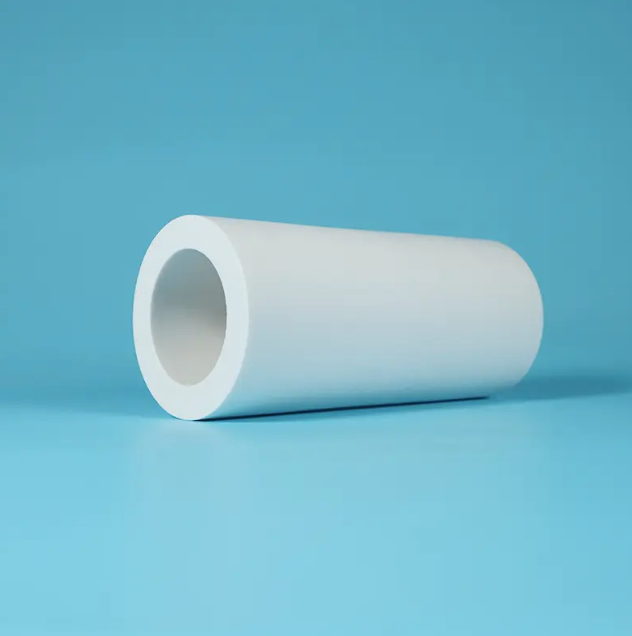
Glass fibers bring a subtle but crucial balance to polymer matrices. By distributing stress evenly across the composite, they restrict excessive movement of the resin chains when temperature or humidity fluctuates. This means the material resists warping, shrinking, or expanding more predictably than its unfilled counterpart. Yet the reinforcement does not make the part brittle. The fibers remain short enough to allow the matrix to bend and recover without cracking, so the finished component keeps a degree of give that pure rigid fillers would eliminate.
A common misconception is that improving dimensional stability automatically sacrifices flexibility. With glass fibers, the opposite is often true in practice. The fibers act like tiny anchors inside the polymer, holding critical dimensions in place while still permitting elastic deformation under load. For applications like snap-fit housings or thin-walled connectors, this means the part holds its shape during assembly and thermal cycling, but can still flex enough to engage or disengage without breaking. The key lies in the fiber length distribution and the degree of adhesion between the glass and the resin.
Properly compounded glass-filled thermoplastics exhibit a nearly flat shrinkage curve compared to neat resins. Instead of large variations between flow and cross-flow directions, the fibers randomize orientation and reduce internal stress gradients. The result is a material that machines, molds, and performs with repeatable dimensions across different environmental conditions. Because the inherent flexibility of the base polymer is retained—just reined in where it causes dimensional drift—designers gain a wider processing window and fewer rejects without switching to a completely different chemistry.
Chemical Compatibility That Goes Beyond the Generic PTFE Data Sheet
Most material selection guides will tell you PTFE resists nearly everything, and for the most part that is true. But if you have ever worked with aggressive process streams at elevated temperatures or under mechanical load, you know that the generic compatibility chart only gets you so far. Real-world chemical exposure rarely matches the clean, single-component lists in a datasheet. Mixtures, trace impurities, thermal cycling, and even the geometry of your seal or lining can shift how PTFE behaves over time. That gap between the published table and your actual process is where failures tend to hide.
A more useful approach is to ask what the datasheet does not show: permeation rates for small molecules like hydrogen chloride or chlorine dioxide, the effect of repeated pressure spikes on cold-flow resistance, or how a specific solvent blend swells the polymer matrix just enough to compromise a gasket groove. Bench testing with your exact process fluid, even for a short duration, often reveals surprises that no generic chart will predict. For example, some fluorinated heat transfer fluids can extract low-molecular-weight fractions from PTFE at sustained high temperatures, leading to gradual embrittlement even though the base polymer remains chemically intact.
Beyond the fluid itself, consider the entire system: mating materials, surface finish, bolt load, and thermal gradients. PTFE can cold-flow under load, allowing aggressive media to reach a stressed area and initiate microcracking that accelerates chemical attack. None of that shows up on a simple compatibility list. The best practice is to combine vendor data with targeted long-term immersion tests under representative conditions, then build in a safety factor for temperature and concentration excursions. That is how you move from a generic PTFE datasheet to a genuinely reliable chemical compatibility decision.
Wear Resistance Testing on Glass-Filled vs. Unfilled PTFE Tubing
Standard wear tests often miss the practical distinction between glass-filled and unfilled PTFE tubing because they focus on idealized contact conditions. In real applications, fillers like glass fibers change how the tubing responds to abrasive slurries, cyclic vibration, and edge loading—not just steady sliding. A more useful comparison comes from running both materials over a rough steel counterface while introducing a mildly corrosive fluid, which reveals that glass-filled PTFE tends to hold its shape longer under intermittent impact but can micro-fracture at the surface, releasing short fiber fragments.
Unfilled PTFE, by contrast, shows rapid initial material loss in dry or semi-dry wear tests, yet it often outperforms glass-filled grades when lubrication is marginal or when the mating surface has a low Ra finish. The wear mechanism shifts from adhesive transfer to fatigue-driven delamination, and the absence of brittle fibers means fewer hard third-body particles. For engineers, the key is to test both materials under the exact duty cycle of the application—especially if the tubing flexes while under pressure, because bending superimposes tensile stress on the wear track and changes the ranking entirely.
Accelerated protocols that run at constant load and speed will frequently mislead. Instead, a stepped load profile with short dwell times reproduces the stick-slip and abrasive packing seen in peristaltic pumps and seal applications. Under that regime, glass-filled PTFE tubing often exhibits a lower steady-state wear rate but a higher variance, whereas unfilled PTFE wears more uniformly. Recording both the mass loss and the change in inner diameter after a fixed number of cycles gives a practical ranking—yet even then, a field trial under actual media conditions remains the only reliable way to choose between the two.
The Machining Trade-Offs When You Move to Glass-Filled PTFE
Switching to glass-filled PTFE brings clear gains in compressive strength and creep resistance, but the moment it hits the machine shop, the material behaves like a different animal. Pure PTFE is forgiving and soft under the tool, whereas the glass fibers act as embedded abrasive particles. You will notice heavier tool wear almost immediately, along with a tendency for the material to chip at the edges rather than peel cleanly.
Tooling choices shift quickly from standard high-speed steel to solid carbide as the bare minimum, with diamond-coated or PCD inserts becoming the practical option for any real production run. Speeds and feeds need to come down because the glass fibers create localized hard spots that generate excess friction heat. Since PTFE already conducts heat poorly, that extra heat has nowhere to go, so shallow passes, sharp tools, and consistent coolant or air blast become necessary to hold tight tolerances.
Surface finish is where the trade-off stings most. Unfilled PTFE can be turned to a smooth, almost polished finish, but glass-filled grades tend to leave small voids and micro-tears as fibers get pulled from the matrix. To get an acceptable sealing face, you often need a secondary polishing step or a switch to slow, fine finishing cuts, which drives up cycle time and tooling cost. The real question is never whether glass-filled PTFE can be machined, but how much extra machining effort the improved mechanical properties are worth.
Selecting the Right Glass Loading for Seals, Bearings, and Valve Seats
Glass loading in PTFE and other fluoropolymers is not a single optimal value across seals, bearings, and valve seats. For seals, 15% glass-filled PTFE often strikes a workable balance: it resists extrusion at moderate pressures while preserving enough compliance to seat against mildly rough surfaces. Raising the glass content to 25% improves wear resistance and allows higher pressure ratings, but the material stiffens noticeably and can score softer metal shafts, especially in dynamic applications. Loadings above 30% are rare for dynamic seals unless the mating surface is hardened and the design specifically handles abrasive debris.
Bearings and valve seats shift the trade-off toward dimensional stability and creep resistance. Bearings using 25% glass-filled PTFE handle substantial load without excessive friction, yet if the shaft is soft or the duty cycle involves frequent starts and stops, dropping to 15% glass can reduce surface scoring while still outperforming unfilled PTFE. Valve seats, which face constant compressive stress and thermal cycling, generally benefit from 20–25% glass loading to maintain tight shutoff and resist cold flow. However, in aggressive media such as hot caustic or hydrofluoric acid, glass filler can be chemically attacked, so lower loadings or alternative fillers like carbon or graphite become the safer choice.
Practical selection should also account for particle size, fiber length, and fiber orientation, which vary by supplier and can shift wear behavior more than the nominal percentage. A tribological bench test with the actual counterface material and surface finish will reveal more than a datasheet value. Matching thermal expansion rates and verifying that the glass loading does not accelerate wear of the mating part are often the deciding factors in long-term performance.
FAQ
The glass fibers embedded in the PTFE matrix act like tiny reinforcements, dramatically reducing the rate of surface erosion when the tube rubs against mating parts or carries abrasive slurries. It keeps dimensional stability longer without sacrificing the low friction base.
It retains PTFE's near-universal resistance to acids, bases, and solvents, though the glass filler slightly lowers tolerance to strong hot alkalis or hydrofluoric acid. For most industrial chemical streams, the difference is negligible and the added wear life is worth it.
Yes, typically they operate comfortably from -200°C to +260°C. The glass filler helps reduce creep at the upper end, so the tube keeps its shape under pressure better than unfilled PTFE at elevated temperatures.
You'll find it in chemical processing lines, pump internals, valve liners, and laboratory equipment where a tube must survive repeated contact with aggressive media and mechanical movement. It's also used in automotive fuel systems and aerospace hydraulic sleeves.
Slightly. Glass filled PTFE is still an excellent insulator and keeps a low coefficient of friction, but the surface is marginally rougher and may not be quite as slick as virgin PTFE. For non-stick critical applications, that trade-off may matter.
Most suppliers offer extruded tubes from a few millimeters up to over 100 mm OD, with wall thicknesses from 0.5 mm upward. Tolerances can be held tight for machined parts, often ±0.05 mm depending on diameter.
It's actually easier to machine because the glass fibers reduce the material's tendency to deform under tool pressure. You can drill, turn, and cut clean threads without the smearing that sometimes occurs with unfilled PTFE.
Conclusion
Standard PTFE tubes often fail in abrasive service because the pure polymer, while chemically inert, suffers from rapid wear and cold flow under load. The real culprit is a lack of mechanical reinforcement: unfilled PTFE deforms under even moderate compressive stress, leading to dimensional instability and premature seal or bearing failure. By adding glass fibers, the picture changes dramatically. The fibers act as a rigid internal skeleton, reducing creep and wear without sacrificing the base material’s inherent flexibility entirely. This balance is critical for dynamic applications where a stiff, brittle tube would crack but a soft, unreinforced one would wear out quickly. The result is a product that holds tolerances better in fluctuating temperatures and pressures, extending service life in demanding environments.
Chemical compatibility in glass-filled PTFE goes beyond the generic PTFE data sheet because the glass addition subtly alters the surface and bulk behavior. While PTFE remains highly resistant to acids, bases, and solvents, the glass fibers can be attacked by strong alkalis or hydrofluoric acid, so the loading percentage must be matched to the specific chemical environment. Comparative wear testing shows glass-filled grades outperform unfilled PTFE by a wide margin in dry sliding or abrasive slurry conditions, though machining becomes more difficult: glass fibers dull cutting tools faster and produce a rougher surface finish. For seals, bearings, and valve seats, selecting the right glass loading—typically 15% to 25%—provides the best compromise between reduced wear, acceptable chemical resistance, and machinability. This tailored approach avoids the one-size-fits-all trap and delivers a solution that actually lasts in real-world service.
Contact Us
Contact Person: Tommy Xiao
Email: [email protected]
Tel/WhatsApp: 8615651509888
Website: https://www.ptfe-factory.com