

ODM Car Ozone Generator Custom Manufacturing Benefits for Automotive Brands
2026-10-10
Odors are one of the few quality signals no test drive can hide. A faint stale smell in a new cabin tells customers more than any brochure ever could. That's why forward-thinking automotive brands are turning to ODM custom manufacturing for car ozone generators—not as a costly add-on, but as a built-in brand safeguard. At LUFUTATECH, we've seen firsthand how custom ozone generator designs help brands differentiate without sacrificing reliability or compliance. Here are the benefits that matter most.
Ozone Output Calibrated to Cabin Air Volume and Material Tolerances
Precise ozone dosing inside an enclosed cabin isn't a fixed setting—it's calculated from the actual air volume the system must treat. A compact two-seat cockpit and a wide-body passenger compartment demand very different output levels to reach the same effective concentration for odor neutralization or microbial control. The calibration logic starts with a volume measurement, then adjusts the generator's duty cycle so the resulting ozone concentration stays within a narrow band that actually works, without wasteful overshoot.
Material tolerances add a second layer of constraint. Rubber seals, silicone gaskets, and certain interior plastics degrade faster when exposed to ozone above specific ppm-hours. Rather than relying on generic thresholds, the output profile is tuned against a material map of the cabin—zones with sensitive elastomers get lower transient peaks, while metal or glass surfaces can handle more aggressive brief exposures. This isn't just about avoiding visible cracking; it's about preserving long-term flexibility and seal integrity after hundreds of cycles.
The end result is a delivery curve that breathes with both the space and its contents. Short bursts followed by decay phases allow the ozone to do its work while keeping cumulative exposure under the tolerance envelope of the least robust material present. Some systems also sample real-time ozone levels near sensitive components and trim the generator output accordingly, moving the calibration from a static lookup table to a closed-loop response that accounts for temperature, humidity, and load variations without ever pushing past the safe edge.
Rapid Prototype Runs from CAD to Sample Unit in Under Four Weeks
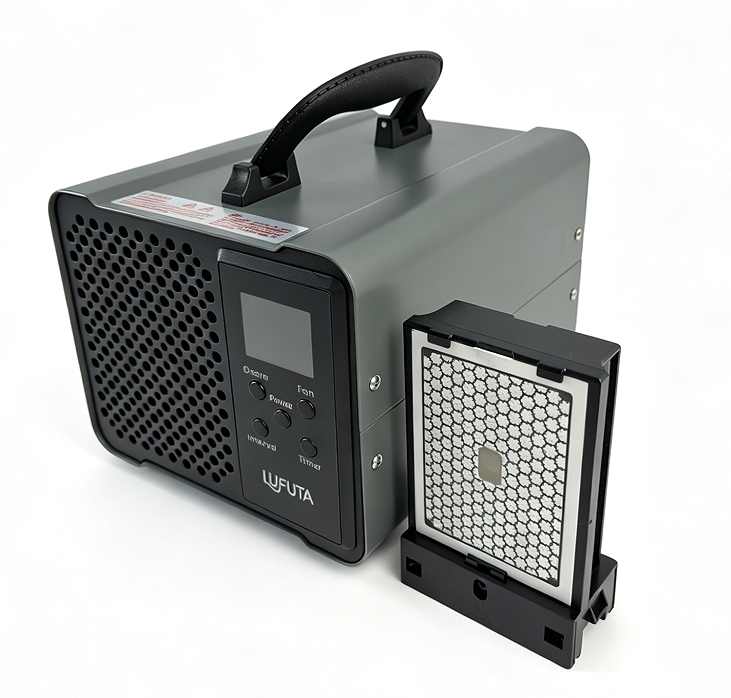
A four-week sample lead time only works when CAD data is treated as the single source of truth from day one. We import the native file, run a printability and machinability check, and lock the split between additive and subtractive steps before anyone starts cutting metal.
Changes that used to require a new tooling loop now happen on the same model. If a boss needs to shift 0.3 mm or a snap feature needs more draft, the update goes straight into the revised toolpath. There is no drawing interpretation lag and no back-and-forth about whether the file matches the sample.
The result is a physical unit that reflects the CAD exactly, in under 28 days. In some programs, we have delivered a functional sample in 19 days because the part family was already proven and no custom finishing was required.
Private Label Housing with Brand Moldings, Not Just Stickers
Most private label enclosures stop at a printed logo or a thin adhesive badge that starts to curl after six months in the field. Brand moldings take a different route: the logo, model name, or custom texture is formed directly into the housing during injection molding. This means the branding sits slightly raised or recessed in the plastic itself, following the contours of the part instead of sitting on top of it.
The practical upside shows up in daily handling. Molded-in branding can be painted, backlit, or left to catch light naturally across textured surfaces. It does not peel, fade unevenly, or leave residue when equipment is cleaned. For products used outdoors, in medical settings, or on factory floors, that durability often matters more than the initial tooling cost.
There is also a subtle design advantage. Because the mold is machined to include brand elements, manufacturers can align recessed details with vents, ports, or structural ribs without adding a second process. The result feels less like a generic off-the-shelf box with a label applied and more like a housing engineered around the brand from the start.
Pre-Approved Designs for EU and North American Air Quality Standards
Across the Atlantic, regulatory bodies in the European Union and North America have established distinct pre-approved design frameworks that manufacturers can follow to demonstrate compliance with air quality emissions limits. These designs are not mere suggestions; they are detailed technical templates covering everything from catalyst substrate geometry to sensor placement and exhaust flow calibration. By leveraging these pre-validated configurations, equipment producers can avoid the lengthy process of full type-approval testing for every model variant, instead focusing their engineering resources on fine-tuning performance within an already accepted envelope.
What sets the EU and North American approaches apart is how each region structures its pre-approval catalogs. The EU tends to cluster designs around Euro emission stages, with specific layouts for diesel particulate filters, selective catalytic reduction systems, and on-board diagnostics tailored to urban duty cycles. North American standards, driven by EPA and CARB requirements, emphasize durability over transient operation and often include provisions for cold-start emissions and high-altitude operation. Engineers working across both markets quickly learn that a pre-approved design for a Euro VI heavy-duty engine may require substantial rework to meet EPA 2027 limits, particularly in the area of ammonia slip control and NOx sensor redundancy.
In practice, these pre-approved designs become a living library that evolves with each regulatory update. Manufacturers submit their own validated configurations to regulators, who then publish them as reference models after independent verification. This collaborative loop has led to some surprising convergences—for example, the latest generation of diesel oxidation catalysts pre-approved for both EU Stage V and US Tier 4 final share nearly identical precious metal loadings despite different test cycles. For smaller firms, tapping into this shared library levels the playing field, allowing them to bring compliant equipment to market without maintaining an in-house emissions laboratory.
Shared Power Modules Across Vehicle Platforms to Lower Per-Unit Cost
Reusing a single power module design across multiple vehicle lines flips the traditional cost equation. Instead of engineering bespoke inverters or DC-DC converters for each model, automakers can amortize tooling, validation, and sourcing over a much larger volume. This approach turns the power module into a common building block, reducing per-unit expense without sacrificing performance for any specific platform.
The savings come from more than just scale. A shared module streamlines supplier negotiations, shrinks warehousing complexity, and lets engineering teams focus on integration rather than reinventing the wheel for every variant. Even when vehicle architectures differ—sedan, SUV, or light commercial—the core power electronics stay identical, with only the mechanical housing or cooling interface adapted locally. That keeps development cycles shorter and frees budget for other differentiating features.
Critics sometimes worry that a common module forces compromises, but modern silicon carbide and gallium nitride devices offer enough headroom to cover a wide range of voltage and power requirements. By defining a flexible specification up front, manufacturers can serve both low-cost commuter cars and high-performance electric trucks with the same base design. The result is a quieter supply chain, fewer part numbers, and a cost curve that improves with every additional vehicle launched on the shared architecture.
Built-In Self-Diagnostics That Flag Electrode Wear Before Failure
A quiet shift in electrode health often starts long before readings drift or fail outright. The onboard diagnostics track micro-changes in impedance, asymmetry potential, and response slope during normal operation, flagging early wear patterns that would otherwise go unnoticed. Because the system learns the electrode's baseline signature, it can distinguish normal aging from accelerated degradation caused by temperature swings, abrasive flow, or chemical attack.
When wear signals cross a preset threshold, the instrument issues a clear maintenance alert instead of waiting for a hard failure. This gives technicians a window to schedule replacement or recalibration without interrupting the batch, line, or field run. Drift-related data errors drop off because a wearing electrode is caught before its output becomes unreliable.
The real payoff shows up in process uptime and data integrity. Rather than reacting to a dead sensor mid-run, operators see a trend line that predicts remaining useful life. That foresight changes electrode care from a calendar guessing game into a condition-based task, trimming inventory surprises and extending the value of every probe.
FAQ
ODM stands for Original Design Manufacturer. Instead of just producing a standard unit, the factory handles both design and manufacturing based on your brand's requirements. You get a product that fits your specific market positioning, from the casing shape to the ozone output calibration, without having to build your own production line.
Generic units often lack brand alignment and may not meet local certification requirements. With ODM, you can control components like the ozone plate material, timer logic, and power regulation to match your vehicle lineup. It also lets you offer a unique product that private-label competitors can't easily replicate, protecting your margin.
Custom manufacturing gives you control over performance parameters such as ozone concentration, fan speed, and noise level. You can also integrate features like smart app control or air quality sensors. From a branding perspective, you get custom enclosures, color schemes, and packaging that reinforce your automotive brand identity.
Different markets have varying safety standards for ozone emission and electrical components. An experienced ODM partner will design the generator to meet certifications like CE, FCC, or RoHS from the start. They can also provide documentation and test reports, saving you from costly redesigns and delays during import.
Many ODM factories offer flexible MOQs, especially if you're willing to pay slightly more per unit for tooling. They understand that emerging automotive brands need to test the market before committing to large volumes. You can often start with a few hundred units and scale up once demand is proven.
Beyond branding, you can customize the ozone output range (e.g., 5-20 mg/h), operating modes like pulse or continuous, timer settings, and power source (12V car socket or USB-C). Aesthetic options include different housing materials, LED indicator colors, and even custom scent cartridges if you want to combine ozone with fragrance.
A typical timeline is 8-14 weeks, depending on complexity. This includes design validation, prototype iteration, safety testing, and tooling. If you already have a clear specification sheet and CAD files, the process can be shortened. Rush orders are possible but often compromise quality control, so it's better to plan ahead.
Look for factories with direct experience in automotive accessories, not just general electronics. Ask about their ozone plate sourcing, lifespan testing data, and ability to provide third-party lab reports. Also check their communication process—do they assign a dedicated engineer or project manager? A good partner will offer design suggestions that improve reliability, not just follow your drawings.
Conclusion
For automotive brands, choosing an ODM partner for car ozone generators means moving past generic aftermarket units. Every ozone output is calibrated to the specific cabin air volume and material tolerances of a vehicle, so the generator delivers the right concentration for odor removal and sanitization without exceeding safe exposure limits. The development speed is equally tailored: CAD drawings turn into working sample units in under four weeks, allowing iterative testing without lengthy tooling waits. Brand identity is embedded in the product itself—custom moldings on the housing reflect the vehicle's design language, not just a sticker added at the end of the line.
Compliance becomes a non-issue because the designs are pre-approved for both EU and North American air quality standards, saving months of certification work. Cost control benefits from shared power modules used across multiple vehicle platforms, which drives down per-unit expenses through economies of scale. On top of that, the built-in self-diagnostics continuously monitor electrode wear and flag potential failures before they happen, reducing unexpected downtime and warranty claims for both the automaker and the end user.
Contact Us
Contact Person: Paul Luo
Email: [email protected]
Tel/WhatsApp: 0086-19966314501
Website: https://www.lufutatech.com