

Ozone Machine Supplier: Your Trusted Source for Advanced Air and Water Purification Systems
2026-10-03
If you've been searching for an ozone machine supplier that actually understands both air and water purification, you know how overwhelming the options can get. At LUFUTATECH, we don't just sell equipment—we engineer systems that tackle stubborn contaminants, odors, and pathogens without the usual guesswork. Whether you're treating a commercial water line or improving indoor air quality, the right ozone technology can make the difference between a temporary fix and a lasting solution. In this guide, we'll walk through what truly matters when choosing a supplier, and why LUFUTATECH has become a go-to source for industries that refuse to compromise on purity.
Why the Right Ozone Output Makes or Breaks a Purification Setup
Ozone output isn't a spec to glance over; it dictates whether the purification process actually finishes the job. Too little ozone leaves organic compounds partially oxidized, which can create even more irritating byproducts than the original contaminants. Too much ozone, on the other hand, doesn't just waste energy—it accelerates corrosion of internal components and can push residual ozone levels past safe exposure limits. The right output matches the volume of the reaction chamber and the expected contaminant load, so every oxidation reaction has enough ozone to complete without excess lingering afterward.
Real purification setups rarely face a static load. Humidity, temperature, and the type of contaminants all shift how much ozone is actually consumed in the reaction. A fixed-output generator might work perfectly in a lab test but underdeliver in a humid space or overproduce in a dry one. That's why adjustable output or properly sized fixed systems are critical—they account for these variables and keep the ozone concentration within the effective window, not just at the generator outlet but throughout the entire treatment area.
Ultimately, the right ozone output changes the user experience from 'it smells clean' to 'it is actually clean and safe to occupy.' Precise output control reduces the need for extended off-gassing periods, avoids the sharp metallic odor that signals overdosing, and protects sensitive materials like rubber seals and electronic contacts. A purification setup lives or dies by this balance: enough ozone to oxidize the target pollutants, but not so much that the treatment itself becomes a new problem.
Inside Our Testing Lab: How Every Unit Earns Its Industrial Badge
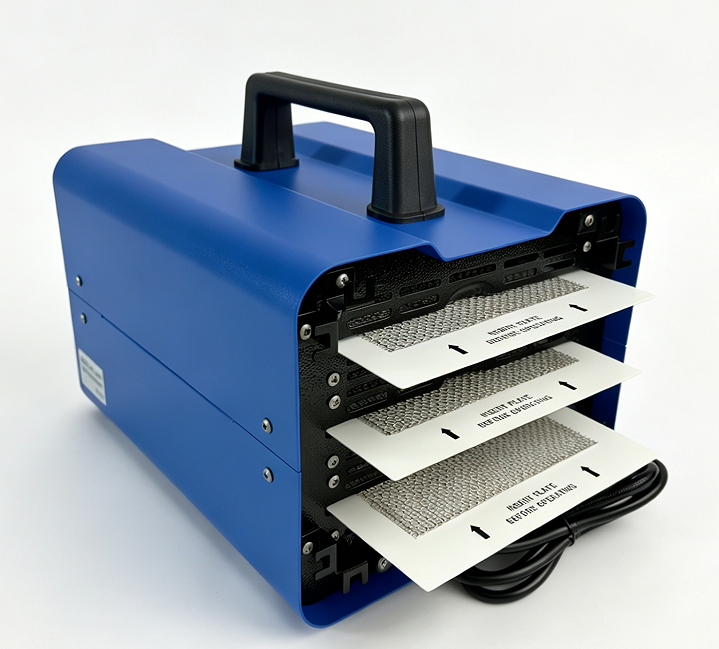
Walk into the lab on any given Tuesday and you'll hear the same thing: a low, steady thrum from the vibration rig, the occasional hiss of a thermal chamber cycling down from 85°C, and someone muttering at a torque graph that refuses to flatten out. There's no velvet rope here, no staged demo for a visiting camera crew. Just rows of prototypes bolted to steel plates, wired into data loggers, and left to prove they can take a beating longer than the warranty says they should.
Every unit that earns the industrial badge has to survive a gauntlet that doesn't care about brand names or marketing copy. We drop them from forklift height onto concrete, bake them in dust boxes until the fans choke, and run them through 10,000 plug cycles on connectors that were never designed to be unplugged that often. One recent power supply looked perfect after the first round of shock tests—came back two days later with a hairline crack in a solder joint that only showed up under a microscope. That one went back to the design team, not the sales floor.
The badge isn't handed out because a unit passed a checklist; it's earned when the test engineer signs off with a note like 'no observable degradation after 3x rated load for 500 hours.' That's the kind of language that doesn't make it into a brochure, but it's what separates the gear that survives a factory floor from the stuff that ends up in a scrap bin by spring.
Air and Water Don’t Play by the Same Rules—Our Machines Handle Both
Most equipment is built for one medium. Air compresses, water resists. Heat moves differently, pressure builds differently, and seals that hold back gas fail instantly against liquid. Trying to force a single design across both usually ends in leaks, corrosion, or a cracked housing.
Our approach starts with the physics, not the marketing sheet. Air systems need wide passages and low restriction. Water systems need tight tolerances and materials that shrug off cavitation. The same pump cannot simply be “adapted” without rebuilding the impeller geometry, bearing load path, and seal chamber. So that is exactly what we do—separate cores, shared monitoring, one responsibility.
What you get is a machine that does not care whether the line is filled with vapor or liquid. It switches, holds pressure, and keeps running. No derating. No workarounds. No excuses about the medium.
The Maintenance Schedule We Give Clients (Not the One in the Manual)
We stopped handing out the manufacturer's maintenance schedule years ago. It assumes a clean room, steady power, and a trained operator who never skips a daily check. Our clients run real equipment in real conditions—roof-top units caked with pollen, compressors vibrating next to a loading dock, chillers that haven't seen a water treatment test since installation. So the schedule we give them is built from the failure data we've collected on their exact machines, the hours they actually log, and the repairs we've already done. No two sites get the same intervals, even for identical models.
The manual might say "inspect belts every 500 hours." We'll write "check belt tension on the second Tuesday after the summer rush, because that's when the stretch typically shows up on your unit." Instead of a blanket "lubricate bearings annually," we flag the three bearings that failed at 14 months on the east side and put them on a 10-month cycle. We also separate "must-do" tasks from "watch items"—clients get a short list of non-negotiables to prevent catastrophic failure, and a longer list of observations to report back. That way maintenance time goes to what actually breaks, not what a generic manual says should be done.
The schedule isn't static, either. Every time we're on site, we update it. If a part lasts longer than expected, we stretch the interval and save the client money. If something fails early, we tighten the cycle and add a note about the likely cause—voltage spikes, condensate buildup, or just a bad batch of filters. After a year, the schedule looks nothing like the manual, and that's the point. It's a living document that reflects the machine as it runs, not as the factory dreamed it would.
When the Sale Is Closed, Our Support Line Stays Open
A purchase might mark the end of a transaction, but it never signals the end of our involvement. Our team stays reachable long after the invoice is settled, ready to troubleshoot, clarify, or simply listen. Whether you need help with installation, have a question about a feature you rarely use, or hit an unexpected snag months down the road, the same people who helped you choose the product are still on hand.
We built our support around real human conversations, not ticket queues that disappear into the void. Call us, email us, or drop by—you'll get direct answers from someone who knows your purchase history and doesn't need to ask for your order number twice. It feels less like a helpline and more like having a knowledgeable neighbor who happens to specialize in what we sell.
That ongoing connection is why many of our customers come back, not just for repeat buys, but for advice on upgrades, maintenance, or even ideas we never advertised. We'd rather spend an extra ten minutes on the phone today than see you struggle tomorrow. Closing the sale opens the door to a longer, more useful relationship.
From Tap Water to Cooling Towers: One Ozone Cell, Many Frontlines
At first glance, drinking water plants and industrial cooling towers seem to occupy opposite ends of the water treatment spectrum, yet they increasingly share a common workhorse: a single electrochemical ozone cell that generates dissolved ozone directly from the water stream without bottled gas or complex feed systems. In municipal tap water, that same compact cell takes over where chlorine pre-oxidation struggles, breaking down taste-and-odor compounds and cutting disinfection byproduct formation before the main treatment train. In cooling towers, it shifts to biofilm and Legionella control, oxidizing organic fouling layers that chemical biocides often miss.
The move from one front to another is not a simple equipment swap. Drinking water demands low, stable residuals and minimal interference with downstream coagulation, so the cell runs at modest current density with longer contact paths. Cooling water, by contrast, punishes the cell with high hardness, elevated cycles of concentration, and temperature swings that accelerate scale deposition on the electrodes. A common retrofit mistake is replacing only the chemical dosing pump while leaving the original reaction tank in place; that ignores flow geometry and ends up with ozone off-gassing instead of dissolving, because the cell never gets the turbulent contact it needs.
The real frontlines, though, are in daily operation and maintenance. In a well-run drinking water plant, one ozone cell can log 18 months of continuous service before electrode replacement, but the same cell in a cooling loop may need cleaning every few weeks due to calcium carbonate buildup and organic load. Experienced operators stop relying on fixed timers and instead trim power output against live ORP and residual ozone readings, adjusting for changes in makeup water quality or heat load. That kind of adaptive control is what lets a single ozone cell hold both the drinking water standard and the cooling tower efficiency line at once.
FAQ
We offer compact units designed for point-of-entry or point-of-use installation, with ozone output ranging from 200 mg/h to 1 g/h depending on household flow rate and water quality. These models handle everything from well water disinfection to removing sulfur odors.
Ozone reacts with odors and bacteria at the source and then reverts to oxygen, leaving no chemical residue. In a busy kitchen, it can neutralize grease-laden vapors and mold spores faster than chlorine-based fogging, but it requires careful control to keep exposure within safe limits.
Only if the ozone level is kept below 0.05 ppm, which typically means intermittent operation with ventilation. For continuous air treatment in occupied rooms, we recommend our low-output units with built-in ambient ozone sensors that shut off when levels approach the threshold.
The ozone generator cell needs inspection every 6–12 months, and the air dryer (if present) should have its desiccant replaced annually. The injection venturi or diffuser may accumulate scale in hard water areas, so a vinegar soak every few months keeps it clear.
Yes, we build recirculating systems that inject ozone into nutrient solution to control root pathogens like Pythium and Fusarium. Output is sized by reservoir volume, and we include an oxidation-reduction potential (ORP) controller to avoid harming beneficial microbes.
Look for a corona discharge cell with a stainless steel ground electrode, an integrated oxygen concentrator, and fail-safe interlocks that cut power if cooling water or airflow stops. Also ask for a destructive catalyst on the off-gas line to prevent ozone from venting indoors.
In clean water at 20°C, half-life is roughly 20–30 minutes. If you need residual disinfection, ozone is not the right choice; it acts fast and then disappears, which is why many bottling plants pair it with a small chlorine or UV step for storage.
Conclusion
Choosing an ozone machine supplier often comes down to one overlooked detail: output calibration. A unit that's undersized leaves bacteria and odors untouched, while an oversized one wastes energy and can damage sensitive equipment. Our approach starts with matching ozone dosage to the actual load—whether it's a small treatment room or a high-volume water line. Every machine that leaves our facility has already been run through a working lab, not just a checklist. We simulate real-world conditions, measure dissolved ozone levels in water and off-gas concentrations in air, and log performance under continuous duty cycles. That's how each unit earns its industrial badge before it reaches your site. Air and water demand different contact times, different injection methods, and different materials—so we don't pretend one configuration fits both. Instead, each system is built around the medium it will treat, with separate pathways for ambient air, off-gas, and aqueous ozone.
Maintenance is where most purification setups quietly fail. We hand every client a schedule based on their actual runtime and water quality—not the generic calendar in the manual. Hard water, high iron, or 24/7 operation changes filter and electrode life dramatically, so our plans adjust for that. After the sale, the support line doesn't close. A technician familiar with your specific installation answers calls, not a scripted call center. That continuity matters when a cooling tower's biofilm levels creep up or a municipal tap water line needs recalibration. From point-of-use drinking water to large evaporative condensers, the same ozone cell technology scales across different frontlines without losing stability. You get one supplier who understands both sides of the molecule's behavior—oxidation that's aggressive enough to disinfect, yet controlled enough to leave no chemical residue behind. That balance is what makes a supplier a trusted source rather than just a vendor.
Contact Us
Contact Person: Paul Luo
Email: [email protected]
Tel/WhatsApp: 0086-19966314501
Website: https://www.lufutatech.com