
Teakwondo Uniform Manufacturer Tips for Choosing Quality Training Apparel
2026-11-16
Most taekwondo uniforms look identical until you sweat in them. The right fabric, stitching, and fit separate gear that supports sharp kicks from gear that slows you down. In this guide, PandaWin Sports breaks down what to check before you buy your next training uniform.
Fabric That Can Take a Roundhouse Without Losing Shape
Most stretch fabrics will bag out after a few hard movements, but this one was built around a dense, multi-directional weave. The yarns are packed tightly enough to resist pulling and twisting, while still giving you the mobility to throw a high kick without fighting the material.
After repeated roundhouse drills, the knees and seat tend to be the first places to sag. Here, the fabric snaps back to its original line because the stretch comes from the structure rather than a loose elastane blend. The result is a pair that keeps its silhouette through long sessions instead of looking broken in after one hard class.
The Seam Test Most Buyers Skip
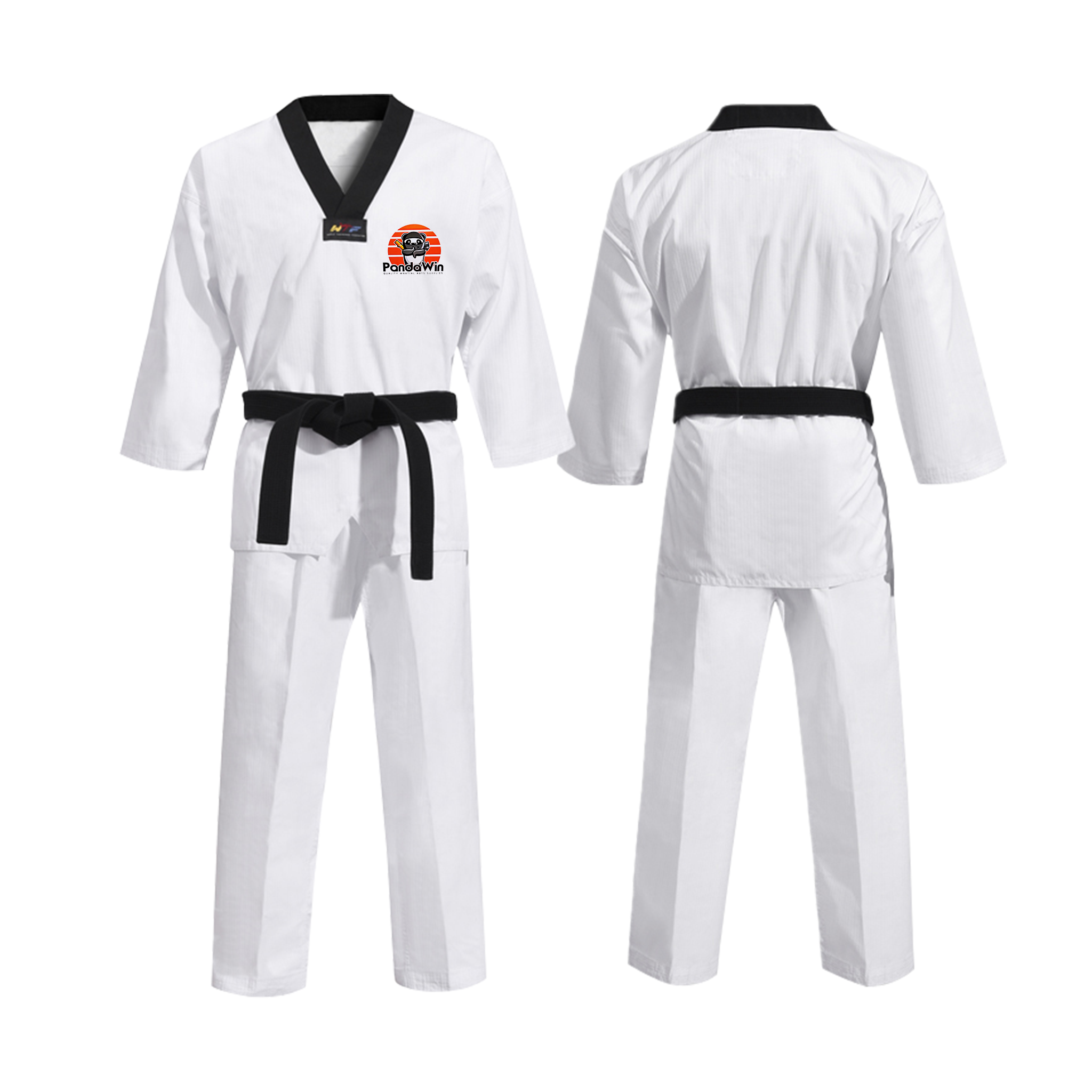
Run your fingers along the stitching where the sleeve meets the body. Most shoppers glance at the outside, admire the color, maybe tug a cuff, and call it a day. But the seam you’re touching? That’s where budget cuts hide. Flip the garment inside out, pull the two sides of that seam gently apart, and look for daylight between the threads. If you can see through the join or the stitches wobble like a drunk line, the piece is already telling you how it will behave after three washes.
Quality construction here means the seam lies flat, the stitch length stays even, and the thread tension doesn’t pucker the fabric into little waves. It’s not about counting stitches per inch like some obsessive tailor—it’s simpler. Hold the seam up to a lamp. A tight, well-finished seam blocks the light almost completely. A loose one glows like a perforated tear-off coupon. That glow is your cue to put it back on the rack.
The reason buyers skip this test is that it feels fussy, like something only a seamstress would do. But you don’t need any skill. You just need ten seconds and a willingness to look at the part of the garment nobody photographs. Do it once, and you’ll start noticing which brands actually reinforce their stress points and which ones rely on a pretty face. The seam never lies, even when the label does.
High Kicks Need More Than a Baggy Cut
A roomy leg can feel freeing until you actually lift your knee above hip height. Then the fabric starts pulling at the crotch, the waistband slides, and what looked like mobility turns into a constant tug-of-war. High kicks expose that gap between looking relaxed and moving without restriction.
The real work happens in a few invisible places. A gusseted crotch gives the seam room to travel instead of snapping tight. Four-way stretch helps, but so does a slightly curved waistband that stays put when your torso tilts. Even the hem matters: too much fabric near the ankle can whip around and break your balance mid-kick.
That’s why the best high-kick pants don’t advertise themselves. They keep the baggy silhouette people want, then quietly add structure where it counts. You get the loose look without that moment of resistance just before the foot reaches its highest point.
Why Lightweight Is Not Always the Right Choice
A stripped-down frame might look appealing on a spec sheet, but shaving grams often means removing the very material that absorbs daily abuse. Ultralight tents, for instance, use thinner floor fabrics that puncture on rocky ground far sooner than their heavier counterparts. The result is not a longer life outdoors but a steady drip of repair tape, patches, and early replacements that erase whatever convenience the lower weight promised.
There is also a stability cost that rarely appears in product photos. A tripod that weighs almost nothing will sway in a mild breeze, and a drill with a hollowed-out housing can vibrate enough to make precise work impossible. In these cases, a little extra mass acts as ballast, keeping the tool steady and predictable when you need it most.
Comfort does not scale downward with weight, either. Chairs, keyboards, and even winter jackets rely on structure and cushioning that cannot be reduced indefinitely without turning everyday use into a compromise. Sometimes the better choice is not the lightest option on the shelf, but the one with enough substance to do the job without demanding constant caution.
Washing Reveals What the Spec Sheet Hides
A drum size and spin speed tell you almost nothing about how a machine handles a week of muddy socks or a delicate wool sweater. The first real wash separates machines that simply move water from ones that actually work fabric loose, rinse out detergent, and leave seams clean without turning collars stiff.
Some models impress on paper with high RPM, yet leave towels crunchy or trap lint in corners after a cycle. Others run quiet but fail to dissolve powder in cold water. You only notice these differences when you pull clothes out, check under the collar, and feel whether the fibers still hold that faint gray film.
Water consumption and cycle length also behave differently under real loads. A machine may quote a short eco program, then extend it by forty minutes once sensors detect an average basket. Repeated washing shows whether that extra time actually removes odors and stains, or just wears fabric down while the spec sheet stays silent.
Questions Worth Asking Before You Order in Bulk
Most mistakes in bulk ordering happen long before payment. The first thing worth pinning down is whether the volume actually matches your real demand, not an optimistic forecast. Look at past usage, shelf life, and the cost of capital tied up in stock that sits around. If the product expires, degrades, or gets replaced by a newer version quickly, that discount may not be worth the risk.
Then ask the supplier the boring questions: what exactly happens if a shipment arrives damaged, how long a reorder really takes, and whether the unit price drops further at a higher tier. Ask for a sample from the actual production batch, not a pre-approved mock-up. A clear answer about lead times and returns tells you more about the supplier than any sales pitch. If any answer feels vague, treat that as a cost of its own.
FAQ
Look at the weave and fabric blend before anything else. A diamond-weave cotton-polyester mix usually breathes better and holds its shape through repeated kicks and washes.
Not necessarily. Extra weight can mean thicker yarns, but poor stitching or weak stress points will tear long before the fabric gives out. Check reinforced seams at the shoulders and crotch instead.
Under 3% for a well-made uniform. If the manufacturer cannot give a shrink rate, assume the pants will climb after a few hot washes.
Competition cuts tend to be lighter with a crisp snap, while daily training gear benefits from reinforced knees, roomier sleeves, and softer collars that won't scratch the neck.
A multi-layer collar with hidden stitching holds its shape better than a single folded strip. Run your thumb along the edge. If it feels spongy and even, it's usually well built.
A hybrid works best: a partial elastic back with a flat front and a sturdy drawstring. This keeps the pants secure during high kicks without digging into the waist.
Cheap blends and low-quality finishing trap sweat and oils in the fibers. Higher-grade fabrics wick moisture faster and resist yellowing, especially if you rinse uniforms soon after training.
With two to three sessions a week, expect twelve to eighteen months from a good uniform. If it's falling apart in under six months, check for stitching failure rather than fabric wear.
Conclusion
A uniform can look crisp on day one and still fall apart after a few hard sessions, so the real judgement starts with fabric recovery. Quality dobok material should snap back after being stretched, twisted, and pulled through repeated roundhouse drills instead of sagging at the knees or cuffs. Seams deserve just as much attention as the cloth, especially along the inseam, armpit, and crotch, where a single weak line of stitching turns a high kick into an embarrassing tear. High kicks also demand more than a baggy cut; a well-placed gusset or articulated panel keeps the leg moving freely without forcing the rest of the uniform to shift. Lightweight fabric may feel convenient in summer, but it often lacks the density needed to survive grappling, sparring contact, and regular washing without becoming flimsy.
That first wash tells you what the spec sheet hides, because shrinkage, pilling, and loose threads only show up after real laundering. Before placing a bulk order, ask the manufacturer for shrinkage rates, colorfastness test results, and whether the sample piece is from the same production line as the final shipment. It is also worth asking about restocking lead times, size consistency across batches, and whether custom embroidery or patches can be added without weakening the fabric. Cost per suit matters less than replacement frequency, so a slightly higher upfront price can save money when the uniforms hold their shape through months of sweat, kicks, and repeated washing cycles.
Contact Us
Contact Person: Fei Xu
Email: [email protected]
Tel/WhatsApp: +8618631245578
Website: https://www.pandawinsports.com/