

Type B RCD Company Essential Guide to Reliable Electrical Protection
2026-09-12
Think your standard RCD has you covered? Think again. As electrical systems evolve—EV charging, solar inverters, HVAC drives—so do the risks of DC leakage currents that ordinary protection can't detect. That's where Type B RCDs step in, and why choosing the right partner matters. In this essential guide, we explore how ETEK engineers reliable protection for today's most demanding installations.
What Type B RCDs Actually Do That Others Can't
Most residual current devices only watch for AC leakage or pulsed DC faults, which leaves a blind spot when smooth DC currents appear. Type B RCDs close that gap by responding to pure DC residual currents up to a specified limit, alongside the usual AC and pulsed DC protection. In practice, that means a Type B unit will trip when a fault produces a steady DC component—something a Type A or Type AC device would simply ignore until it's too late.
The real difference shows up in modern installations with three-phase rectifiers, EV chargers, PV inverters, or certain medical equipment. These systems can generate continuous DC fault currents under specific failure conditions. A Type B RCD continuously monitors the current balance and uses a dedicated detection circuit for smooth DC, so it disconnects even when the fault has no alternating component. Without that capability, a circuit could stay energised while leaking dangerous DC current to earth.
Beyond detection, Type B RCDs are designed to remain stable in environments with high-frequency harmonics or DC offset on the supply. Ordinary RCDs can become desensitised or nuisance-trip when exposed to such conditions, but Type B models maintain their tripping threshold across a wider frequency range. This makes them the only practical choice for circuits where DC faults are possible but operational reliability cannot be compromised.
Why Your Standard RCD Leaves Dangerous Gaps
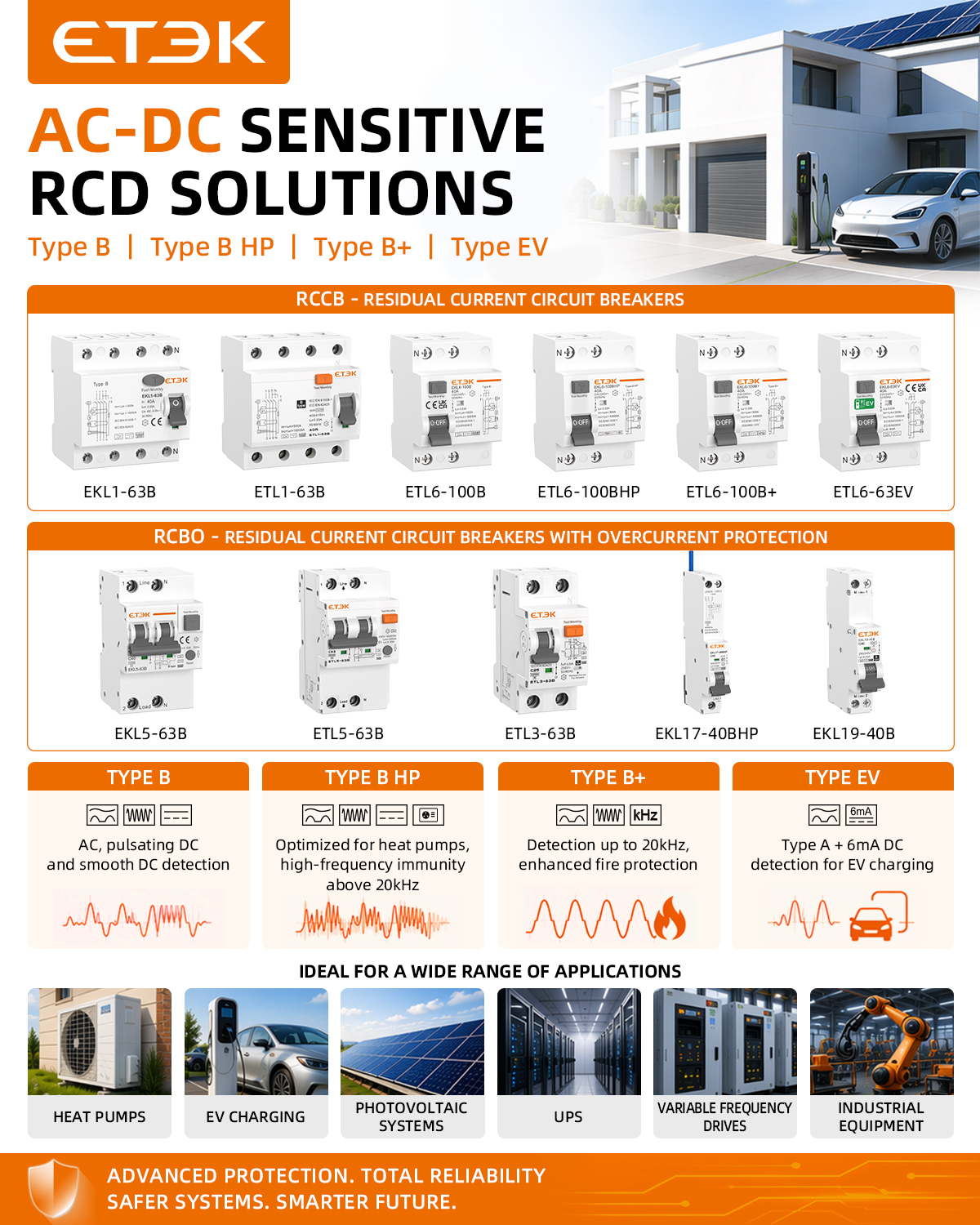
Most standard residual current devices are tuned for textbook sine-wave leakage. The moment a fault current carries a DC component, a high-frequency ripple, or an irregular waveform from modern loads like variable speed drives or switch-mode power supplies, that same RCD can become blind. An AC-type unit, for example, won't even register smooth DC leakage, while many A-type designs go numb when the current isn't a clean alternating pulse. The result is a protection device that sits silently while a genuinely dangerous fault continues to flow.
There's another gap that gets less attention: the low-current dead zone. A typical 30 mA RCD is tested and rated at its tripping threshold, but real-world leakage often builds up slowly. At 15 mA or 20 mA, the device may hesitate for seconds, or not react at all. In a wet room or for anyone with a compromised heart, that delay is more than an inconvenience—it's a window where a fatal shock can occur. Standard RCDs simply aren't designed to catch the slow, creeping faults that end up hurting people.
The problem extends to what the RCD doesn't monitor. It only compares current between live and neutral; if the protective earth conductor itself corrodes or breaks somewhere upstream, leakage can find an alternative path that bypasses the RCD's sensing coil entirely. You're left believing the circuit is protected, while the actual fault path is completely outside the device's view.
Reading the Fine Print on Type B RCD Specifications
Type B RCDs are often the only safe choice for installations with three-phase rectifiers, variable speed drives, or EV charging equipment, yet the devil lives in the specification tables. Manufacturers list a maximum residual operating current, but the real question is how the device behaves with smooth DC, pulsating DC, and high-frequency AC superimposed on a 50 Hz fault. A unit rated for 30 mA may trip reliably at 30 mA of pure AC, while the same device could need 60 mA or more to respond to a smooth DC fault, depending on the exact wording of IEC 62423. Without reading that fine print, a designer can easily assume a level of protection the hardware never promised.
Frequency response is another detail that gets buried in the footnotes. A Type B RCD might list a range up to 2 kHz, but the tripping threshold often rises sharply above a few hundred hertz. In a drive system, the leakage current is rarely a clean sine wave; it contains harmonics from switching frequencies that can reach 10 kHz or more. If the specification only guarantees operation up to 1 kHz and the application produces leakage at 8 kHz, the RCD may not see that component at all. The result is a false sense of security, because the device simply ignores the very current it was installed to interrupt.
Surge immunity and unwanted tripping clauses deserve equal attention. A small note stating “withstands 8/20 µs surges up to 3 kA” might look impressive, but it does not tell you how, or whether the RCD remains functional after repeated surges. Some units shift their trip threshold permanently after a heavy transient, a behavior rarely shown in marketing summary sheets. Reading the full type test conditions, the temperature derating curve, and the exact wording around “non-tripping under load” can expose weaknesses that a quick glance at a datasheet front page would miss. The fine print is not legal filler; it is where the engineering limits are actually declared.
Selecting a Type B RCD Manufacturer You Can Trust
Picking a supplier for Type B residual current devices isn't just about ticking a box on a spec sheet. You need a partner who understands the quirks of DC-sensitive protection, from smooth DC fault currents to high-frequency noise. Look beyond glossy brochures and dig into how they test their units under real-world conditions – short circuits, harmonics, and temperature swings. A trustworthy manufacturer will openly share failure rates, warranty terms, and field performance data without making you chase them for it.
The best indicator of reliability often comes from other engineers who've installed the same RCDs in tough environments. Ask about their track record in solar farms, EV charging hubs, or industrial drives where nuisance tripping and silent failures are costly. A manufacturer worth trusting will have a clear path for technical support when something goes sideways – not just a call center script, but access to actual design engineers who can help you troubleshoot a tripping issue at 2 a.m. Their documentation should read like it was written by someone who's stood in front of a live panel, not a marketing intern.
Also pay attention to how they handle revisions and recalls. Every RCD line hits a bad batch sooner or later; what matters is how fast and transparently the vendor responds. Do they proactively notify distributors and end users? Do they publish clear serial number ranges? A manufacturer that hides behind vague “quality improvement notices” is one you'll regret trusting. Choose a partner who treats a single failed unit as an opportunity to prove their commitment, not as a liability to bury.
Common Installation Mistakes That Undermine Protection
Placing surge protectors or circuit breakers in damp, dusty, or vibration-prone spots quietly erodes their lifespan. A device mounted too close to heat sources or exposed to direct sunlight may trip prematurely or fail without warning, leaving the very equipment it was meant to guard completely exposed.
Another frequent slip is ignoring torque specifications on terminal connections. Loose lugs create resistance that builds heat over time, while overtightened ones can crack housings or compress conductors unevenly. Both conditions invite arcing and intermittent faults that no monitoring system will flag until damage has already occurred.
Skipping proper grounding or assuming an existing rod is still effective often turns a well-intentioned install into a liability. Corroded clamps, undersized bonding jumpers, or separate ground paths that differ in potential can force fault current through unintended routes, frying sensitive electronics instead of safely diverting the surge.
A Practical Checklist for Long-Term RCD Reliability
Start with the basics: verify that every RCD in the installation is correctly rated for the circuit it protects. A 30mA device on a socket outlet circuit is standard, but if you're dealing with equipment that has naturally high leakage currents, a 100mA or 300mA unit may be more suitable to avoid nuisance tripping. Mismatched ratings are a common cause of premature failure, so check the datasheet against the actual load, not just the nameplate.
Next, build a routine that actually gets followed. Quarterly manual testing using the test button is a minimum, but field experience shows that many RCDs fail silently between checks. If possible, use an RCD tester to measure trip time and current at least once a year. Write the results down—even a simple logbook beats memory when a fault appears months later. Dust, vibration, and moisture all shorten the life of the internal solenoid, so keep enclosures sealed and clean, especially in industrial or outdoor settings.
Finally, treat every trip as a signal, not a nuisance. Repeated tripping often points to an underlying insulation breakdown or a ground fault that will only get worse. Instead of just resetting the device, take five minutes to isolate the circuit and check for damaged cords, wet junction boxes, or overloaded power strips. If the RCD itself is suspected—warm to the touch, slow to reset, or failing the test button—replace it immediately. A reliable RCD isn't a set-and-forget component; it's the last line of defense, and it needs attention to stay sharp.
FAQ
Because many devices today use rectifiers, variable speed drives, EV chargers, and other electronics that can inject smooth DC residual currents. Standard Type AC or Type A RCDs may fail to trip on those faults, leaving circuits unprotected. Type B units detect both AC and DC leakage, so they remain effective even when a smooth DC component is present.
A dependable unit typically combines robust construction, certified compliance with recognized standards, consistent tripping performance across AC and DC waveforms, and clear testing instructions. It should also withstand transient conditions without nuisance tripping while still responding quickly to genuine faults.
They are necessary in installations with three-phase rectifiers, electric vehicle charging points, solar inverters, UPS systems, medical imaging equipment, and certain industrial drives. Any circuit that can produce smooth DC residual current above a few milliamps should use a Type B device.
Start with the maximum permissible touch voltage and the expected leakage current. Most commercial circuits use 30 mA for personnel protection, but higher ratings like 100 mA or 300 mA may be chosen for equipment protection or where background leakage is high. The key is ensuring the RCD trips fast enough under fault conditions without causing frequent false trips.
The physical installation is similar to standard DIN-rail RCDs, but you must pay attention to incoming and outgoing connections, polarity, and earthing arrangements. Some models require separate toroids or control modules, so the manufacturer's wiring diagram should be followed exactly. Testing after installation is essential to confirm correct response.
A manual test using the built-in test button should be done at least every six months, but many facilities test monthly or quarterly. In addition, periodic injection tests with a suitable RCD tester that can simulate DC and mixed-frequency residual currents are recommended at least annually to verify the trip threshold and timing.
Mistakes include using the wrong type for the application, improper earthing, connecting neutral and protective conductors carelessly, ignoring ambient temperature limits, and failing to test after installation. Also, multiple RCDs in series can cause selectivity issues, so coordination must be checked.
For circuits that can generate smooth DC residual current, yes. The extra cost is small compared with the risk of electric shock, fire, or equipment damage. Choosing a cheaper, inadequate type can leave critical faults undetected, so the investment usually pays for itself through improved safety and fewer unexplained trips.
Conclusion
Type B RCDs earn their keep by responding to residual currents that ordinary devices simply cannot detect. While a standard unit may trip on alternating current faults, it stays silent when smooth DC or high-frequency leakage appears—exactly the kind of current generated by EV chargers, variable-speed drives, and modern solar inverters. That blind spot can leave equipment energized and personnel exposed. Type B devices bridge this gap by monitoring a wider spectrum, including pulsating and pure direct currents. Yet not all Type B units behave identically; the fine print on specifications matters. Look beyond the headline rating and examine trip thresholds, frequency response, and immunity to nuisance tripping. A unit that meets the letter of the standard may still fall short in a harsh industrial setting, so comparing datasheets side by side is rarely wasted effort.
Choosing a Type B RCD manufacturer is as much about engineering support as about the hardware itself. A trustworthy supplier provides clear test reports, realistic installation guidance, and a willingness to discuss application limits. Field failures often trace back to avoidable mistakes: undersized wiring, improper neutral connections, or mounting the device where heat and vibration alter its sensitivity. These errors undermine even the best equipment. A practical reliability checklist should include periodic trip tests, visual inspection of terminals, and verification that downstream loads have not changed in character since commissioning. Long-term protection is not a one-time purchase; it is a habit of checking, adjusting, and questioning assumptions. Companies that treat Type B RCDs as part of a living system—rather than a checkbox item—rarely regret the extra attention.
Contact Us
Contact Person: Andy
Email: [email protected]
Tel/WhatsApp: +86 13356133008
Website: https://www.etek-china.com/